PHCC of Georgia Applauds Passage of Senate Bill 553 to Protect Georgia Consumers and Licensed Contractors
July 1, 2026

CUMMING, GA — The Plumbing-Heating-Cooling Contractors Association of Georgia (PHCC of Georgia) applauds the passage of Senate Bill 553, an important step toward protecting Georgia consumers and supporting licensed plumbing professionals across the state.

SB 553 strengthens consumer protection by prohibiting individuals and businesses from advertising or offering plumbing services that require a state license unless they are properly licensed under Georgia law. The legislation helps ensure that consumers can have greater confidence that the contractor they hire has met the education, examination, and experience requirements established by the State of Georgia.

"Licensed contractors invest significant time and resources to meet Georgia's professional standards," said Karen Hill, President of PHCC of Georgia. "This legislation helps create a fair marketplace while reinforcing the importance of hiring qualified professionals to perform work that directly impacts public health and safety."

PHCC of Georgia thanks Governor Brian Kemp, the members of the Georgia General Assembly, and the bill's sponsors for recognizing the importance of protecting consumers and preserving the integrity of Georgia's licensed construction trades.

As the state's oldest trade association representing plumbing, heating, cooling, and mechanical contractors since 1892, PHCC of Georgia remains committed to advancing professional excellence through education, workforce development, advocacy, and ethical business practices.

For more information about PHCC of Georgia or to learn more about hiring licensed professionals, visit www.phccga.org. 


HVACR Industry Coalition Supports Senator Ernst’s SMART Energy Efficiency Standards Act, S. 4892


July 7, 2026
By Staff Writer, PHCC-National Association

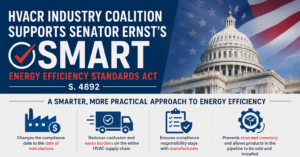
July 7, 2026 — A coalition of HVACR trade associations announced its support for Senator Joni Ernst’s introduction of the SMART Energy Efficiency Standards Act, S. 4892, legislation to change the compliance date for regional HVAC energy efficiency standards to the date of manufacture.

The coalition includes the Air Conditioning Contractors of America (ACCA), the Air-Conditioning, Heating, & Refrigeration Institute (AHRI), the Heating, Air-conditioning & Refrigeration Distributors International (HARDI), and the Plumbing-Heating-Cooling Contractors—National Association (PHCC).

In its letter to Senator Ernst, the coalition wrote that S. 4892 would “amend the Energy Independence and Security Act of 2007 by changing the compliance date for regional energy efficiency standards for furnaces, central air conditioners, and heat pumps to the date of manufacture,” reducing confusion and easing burdens on manufacturers, distributors, and contractors.

The letter explains that the current date-of-installation structure creates unnecessary disruption throughout the HVAC supply chain.

“Under current law, compliance with regional energy efficiency standards is based on the date equipment is installed rather than the date it is manufactured,” the coalition wrote. “This creates unnecessary complexity throughout the HVAC supply chain by effectively causing otherwise fully compliant equipment to expire after it has been legally manufactured, purchased, and distributed.”

By contrast, the coalition wrote that a date-of-manufacture standard “places compliance responsibility where it belongs—with the manufacturer—and ensures that every product entering the distribution chain complies with applicable Department of Energy requirements.”

The letter also notes that the bill would allow products already in the distribution pipeline to continue to be sold and installed, “preventing legally manufactured and purchased equipment from becoming stranded inventory.”

“America’s HVAC manufacturers, distributors, and contractors, who make, distribute, and install some of the most innovative and energy-efficient products in the world, appreciate your leadership in introducing this much-needed legislation,” the coalition wrote. “The SMART Energy Efficiency Standards Act will provide business certainty throughout the HVAC supply chain, reduce unnecessary costs and complexity, and ensure a more orderly transition to future energy efficiency standards.”

The coalition thanked Senator Ernst for her leadership and said it looks forward to working with her to advance S. 4892.

###

About HARDI: https://hardinet.org/about/

About PHCC: https://www.phccweb.org/about/

About ACCA: https://www.acca.org/about-acca

About AHRI: https://www.ahrinet.org/about-ahri


HARDI, PHCC, and ACCA Announce Legal Challenge to Portions of EPA Technology Transitions Reconsideration Rule

June 25, 2026
By Industry News Release

June 25, 2026 — Heating, Air-conditioning & Refrigeration Distributors International (HARDI), Plumbing, Heating, Cooling Contractors – National Association (PHCC), and Air Conditioning Contractors of America (ACCA) today announced they have filed a challenge to parts of the Environmental Protection Agency’s (EPA) Technology Transitions Reconsideration Rule. The amended provisions increase demand for hydrofluorocarbon (HFC) refrigerants in the supermarket, retail food, and cold storage sectors as the supply is being reduced by law, violating the American Innovation and Manufacturing (AIM) Act and threatening to destabilize the refrigerant market. HARDI, PHCC, and ACCA represent wholesale distributors and contractors in the heating, ventilation, air conditioning, and refrigeration industry.

“For the EPA to completely abandon the timelines for transitioning to next-generation products proposed by industry in 2021 misses the mark,” said Talbot Gee, CEO of HARDI. “The final reconsideration rule’s treatment of commercial refrigeration is legally flawed, economically reckless, and directly at odds with the AIM Act. The EPA ignored industry data and over a decade of industry work to prepare for this transition, in violation of the AIM Act’s requirements. HARDI will always push back on agencies that violate the law in writing regulations affecting our industry.”

The joint petitioners strongly oppose the decision to extend deadlines for major commercial refrigeration applications, thereby allowing the continued manufacture of new systems using high-GWP refrigerants. The AIM Act requires a statutory phasedown of HFC supply across the economy, meaning quantities will continue to decline, while the final rule increases demand for refrigerants.

“PHCC members are working hands-on and helping customers navigate refrigerant changes every day,” said Cindy Sheridan, CEO of PHCC. “Allowing legacy refrigerants to be used longer in new commercial refrigeration systems creates confusion for the contractors who install and service this equipment and hurts consumers. The EPA’s own analysis projects a 12- to 24-percent increase in U.S. refrigerant prices by 2029 as a result of these delays, since the AIM Act will continue reducing the supply of these older refrigerants to support the domestic production of next-generation refrigerants.”

By allowing extended use of legacy HFCs in retail food refrigeration and cold storage, the final rule reduces the availability of refrigerants for other sectors, such as residential air conditioning.

“While ACCA appreciates EPA eliminating the install deadline for R-410A split-system equipment, the rule’s delayed refrigeration transition will significantly increase the demand for the limited supply of HFC refrigerants and will drive up costs for contractors and their customers,” said Martin Hoover, Interim President and CEO of ACCA. “This change will also increase pressure for a rushed transition to highly flammable A3 refrigerants and encourage a patchwork of state regulations.”

The joint petitioners support EPA’s decision to provide relief from the installation prohibition for existing split-system residential and light commercial air conditioners and heat pumps, a policy the organizations have long advocated for to prevent stranded inventory and avoid disruption for distributors, contractors, builders, and consumers.

The joint petitioners believe the final rule’s rationale rests on the false premise that the original Technology Transitions Rule had already increased grocery consumers’ costs. The commercial refrigeration restrictions at issue had not yet taken effect when EPA proposed the reconsideration rule and could not have been responsible for higher grocery prices.

The trade associations emphasized that the original Technology Transitions Rule applied to new equipment and did not require grocery stores, cold storage operators, or other businesses to replace existing systems. Existing equipment could continue to be used and serviced.

###

About HARDI: https://hardinet.org/about/

About PHCC: https://www.phccweb.org/about/

About ACCA: https://www.acca.org/about-acca
 Women In The Industry